
Greene Report Date Windows
A headline date covers only the day the article was posted. Inside, entries carry dates of their own. The July report stretched across many days and even gained updates after publication. The radio version covered a shorter stretch. Neither runs on a fixed schedule.
Before trusting a report, note the first and last event dates it lists. Weekends and holidays complicate things. Days of activity often get folded into one later story. No county rule promises a Monday batch of arrests. A newer article does not guarantee that everything since the last issue appears in it. Treat the text as a chosen sample of sheriff activity, not a complete log.
Found a gap? Request records from the Sheriff. Give a narrow date range, a name, a location, and the record type. For present custody, call the Sheriff or IowaVINE rather than waiting on the next article.
Greene Arrest Narrative Limits
A narrative can name a warrant, a call, or an investigation. It may hold no arrest anywhere in it. Even "booked into the jail" stops short of much. It says nothing about current custody, bond, a booking number, or a court result. Watch the verbs. Not every named person belongs on an arrest list.
The reports still place an event in time and name the agency. They also hand you search terms for a focused records request, which a roster never does, and any future county roster would raise its own questions about fields, update times, photos, and released persons.
A name, an age, and a town can fit more than one person in Greene County. Match it against a booking or court case.
Greene County’s Multi-Day Blotter
The county itself publishes no arrest-log database. The strongest public route is the Greene County News Online Sheriff's Report series. Each article reproduces dated law-enforcement activity and stays readable after newer installments land. These are independent news reports, not county records. Keep the label straight.
The long July 2026 piece was posted July 27 and updated August 4. Entries inside run from July 5 through July 31. That uneven span is why you should inspect each article instead of assuming a tidy week or month. Raccoon Valley Radio also runs shorter date-range reports. Nothing in stated county policy fixes the cadence, the weekend handling, or the posting lag.
The full July report sits at the link.

The blotter spans several days, which aids lookup, though it does not serve as a current jail roster.
Read Greene Arrest Reports Carefully
Start with the dates. Then work backward through the daily headings. Along the way, check whether an item actually says arrested or booked, since many entries describe dispatches, crashes, civil papers, patrol checks, animals, or investigations instead. A named person may never have been booked.
- Note the report’s publication and update dates.
- Find the event date and time inside the article.
- Identify the agency, location, and action described.
- Separate alleged charges from unrelated service calls.
- Confirm current custody through the Sheriff or VINE Arrest Check.
- Check the later court disposition through Iowa Courts Online.
News narratives cannot answer a live custody question. For who is in jail right now, use Arrested Today.
Fields in Greene Arrest Reports
Newspaper entries carry fewer facts than a booking file. They often hold just enough detail to point you toward the official record.
| Reported item | How to interpret it |
|---|---|
| Date and time | Usually the reported activity time, not necessarily jail intake. |
| Name, age, or town | Useful identifiers that still require verification. |
| Agency or activity | Shows the narrative context around the event. |
| Arrested or booked language | Indicates custody action in that dated account. |
| Alleged charge | An charge, not a court result. |
| Usually absent | Booking number, live status, bond field, and photo gallery. |
A news item is only a starting point. Confirm the name and the outcome against an official booking or court file.
Reports Mix Arrests and Calls
Greene County News Online reports mix booked and arrested entries with the Sheriff's wider work. Traffic stops, accidents, warrants, patrols, and service calls all share the page. So read the blotter with care. It traces county activity over time. It is not a clean list of jail admissions.
Raccoon Valley Radio's shorter Greene County sheriff's report takes the same approach in a tighter date range.
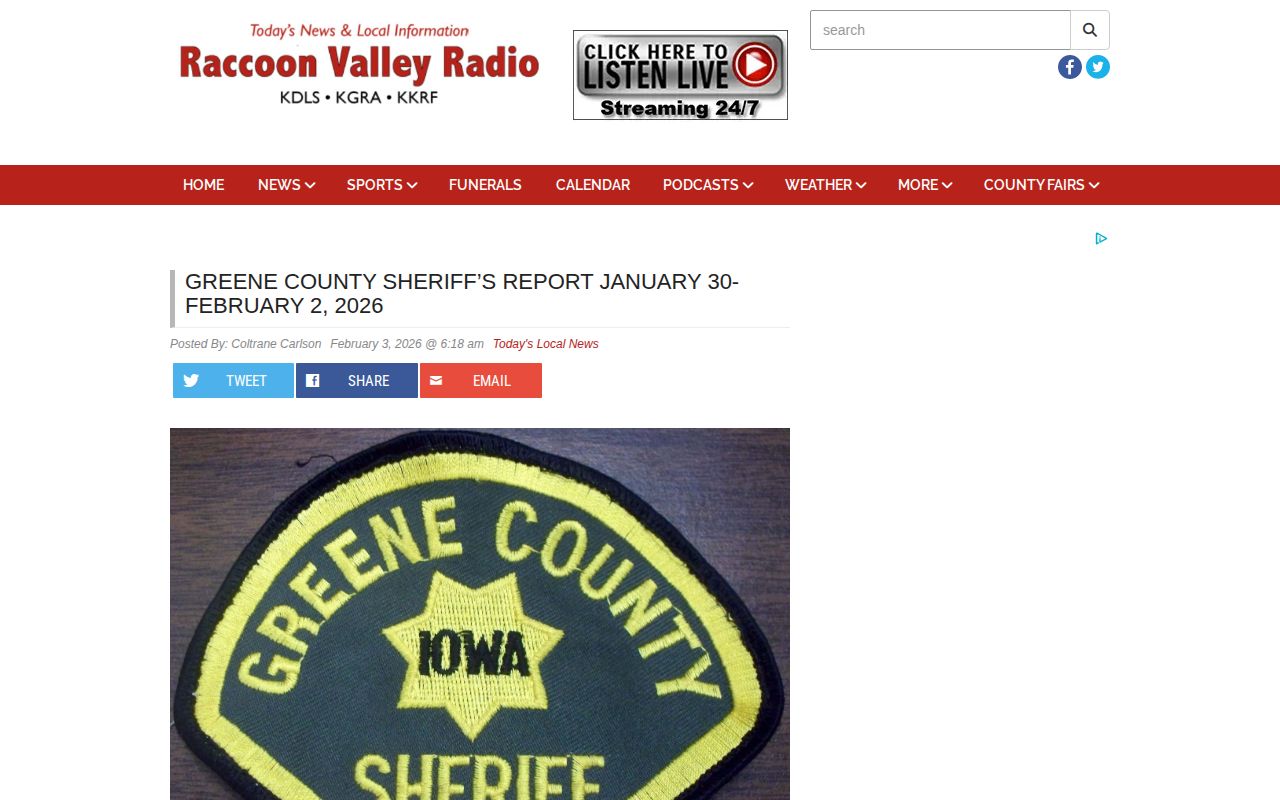
The second source confirms the dated narrative pattern while remaining secondary and non-live.
Greene County Archive Paths
Current report articles can linger online, but that says nothing about the Sheriff's retention schedule. For older local context, try the Greene County Community History Archive and the State Historical Society of Iowa newspaper guidance. Old Jefferson Herald pages carried labels like "Sheriff Clipboard" and "Police Beat." Archived news is a secondary narrative. It proves nothing about current custody.
The state Greene County records catalog lists holdings. It also maps research routes.
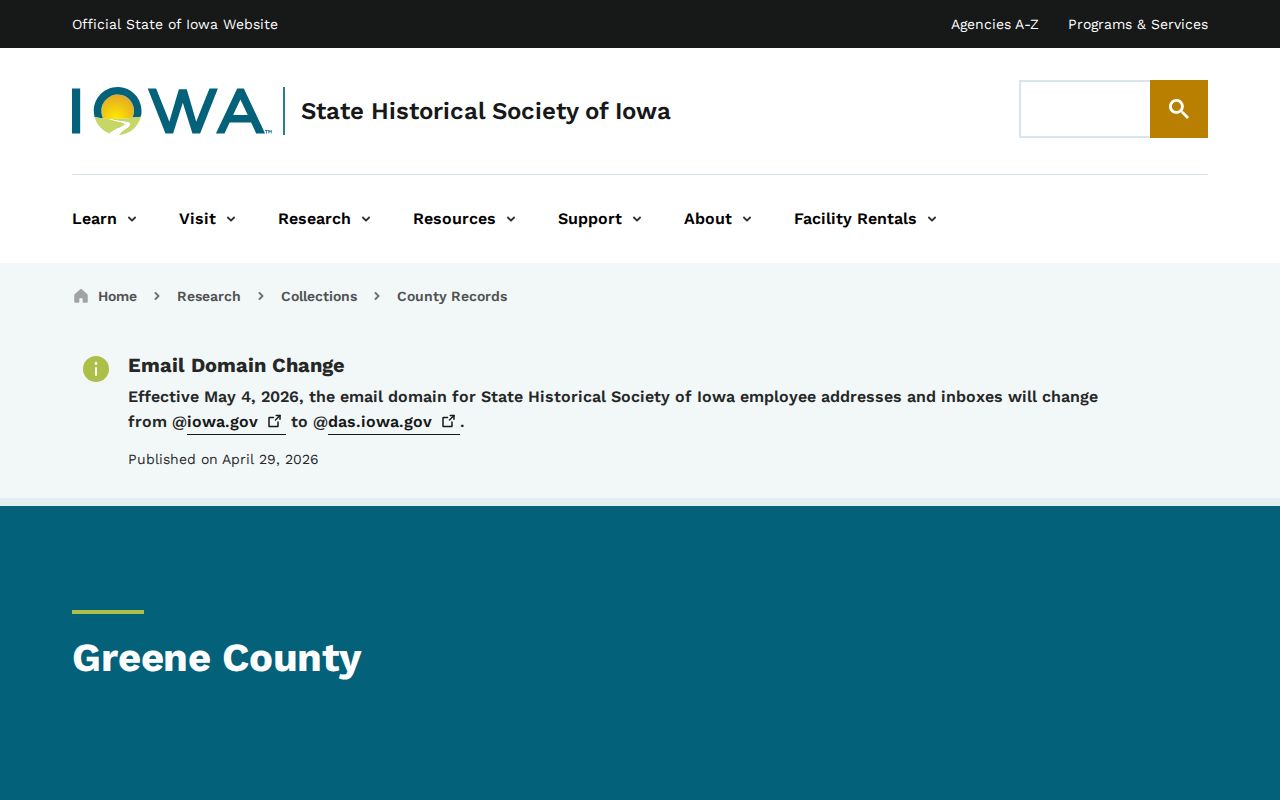
This path suits history research. It will not answer a recent-arrest check.
When a modern report goes missing, ask the Sheriff for a specific arrest or offense record at 515-386-2136. Name the person, the date range, the location, and the record type. Chapter 22 allows reasonable costs. It does not force an agency to build a new list. Request an estimate and the retention policy.
Verify Arrest Reports Officially
The Greene County Sheriff comes first for custody. IowaVINE handles qualifying custody-event checks and alerts, while Iowa Courts Online carries the case after booking. The Greene County Clerk of Court can locate a specific trial-court record. Open-ended research is not that office's job.
- Booking
- Jail intake after custody begins.
- Blotter
- A dated activity report that may include far more than arrests.
- Disposition
- The court’s later resolution.
- Archive
- Stored older material whose presence does not show current custody.
Greene County bookings sit in one bucket. State prison, federal custody, and immigration detention are entirely different systems. Use the IDOC, BOP, and ICE lookup tools only for the custody type each one covers, never in place of a Greene County booking report.
Requesting the Source Arrest File
A newspaper brief can become a tight records request. Pull the full name, the event date, and the approximate time. Add the spot, the agency, and the reported charge. Then ask in separate lines for the arrest or offense report and the booking record. Request custody and release fields, plus any releasable booking photo. A clip in the paper guarantees nothing. None of those four items must exist with the Sheriff or the publisher. The Sheriff lists no online request form and no posted fee schedule. Iowa's Chapter 22 allows reasonable retrieval and copying costs, plus review for confidential material. Request an estimate up front. Ask for electronic delivery where offered and for the statutory basis of any withheld portion. No office must build a custom report. It need not chase a broad research question or compute data that does not exist. Jefferson Police may have written the source report. If so, confirm whether the city custodian or the shared Law Enforcement Center issues the copy. Grand Junction relies on county contract policing, so the Sheriff is the sensible first call. Scranton offers no current online police records route. The agency that created the file and the jail custodian can be two different offices. A single request may miss records the other holds.